
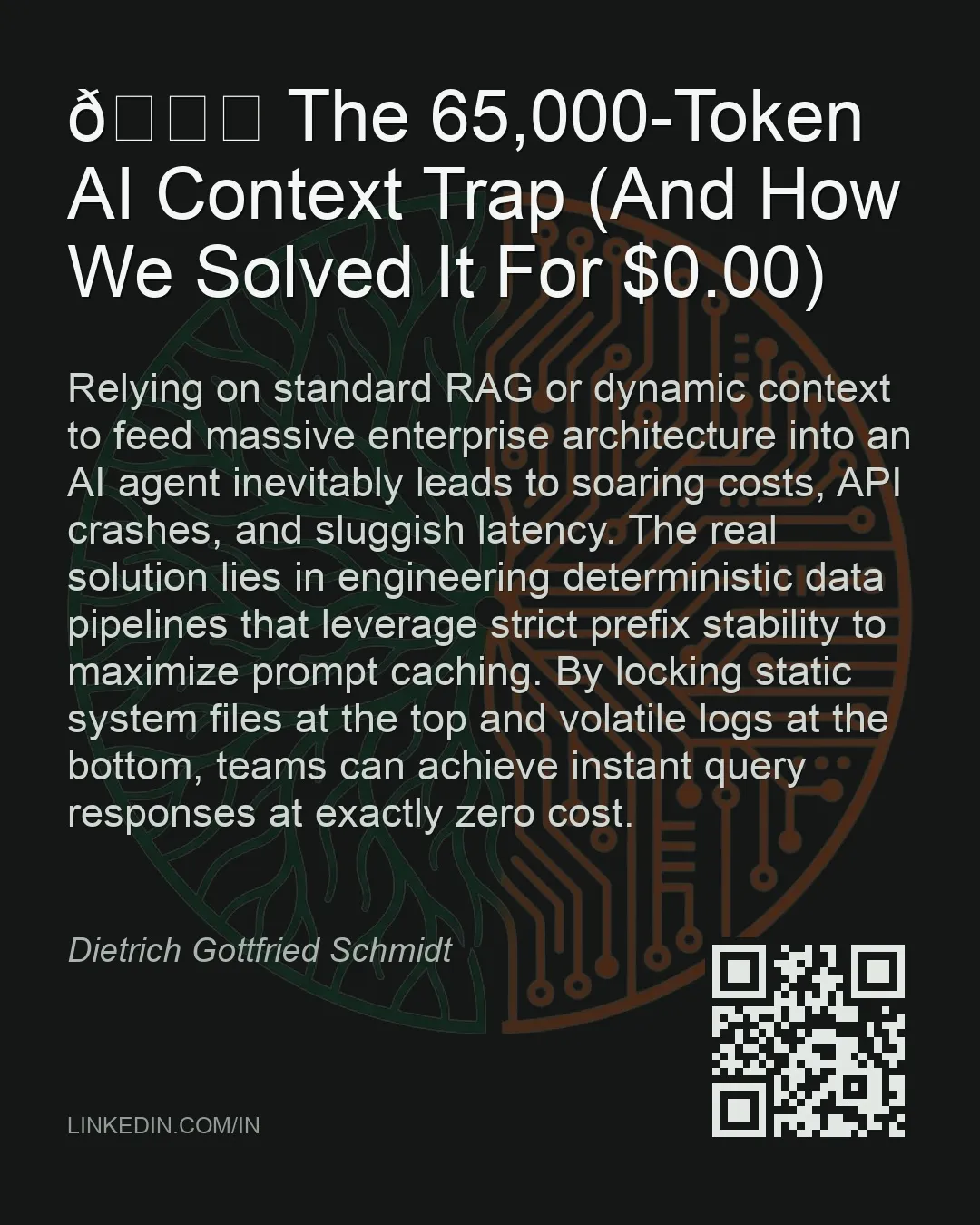
How do you pass 65,000 tokens of complex enterprise architecture to an AI agent, get a highly accurate response in 1.5 seconds, and pay exactly $0.00?
How do you pass 65,000 tokens of complex enterprise architecture to an AI agent, get a highly accurate response in 1.5 seconds, and pay exactly $0.00?
You stop relying on AI to write your context on the fly, and you start engineering your data pipelines for Prefix Stability. 🧠⚡
As a Solutions Architect building AI orchestration pipelines (leveraging tools like Roo Code, LiteLLM, and Claude 3.5 Haiku via AWS Bedrock), I recently tackled a massive bottleneck in our Agentic workflows: The Context Trap.
We needed our AI agents to understand the entire architecture of a complex enterprise platform. They needed to know our PHP and database versions, our exact AWS ECS deployment infrastructure, our custom Drupal module hierarchy, and—crucially—the daily session logs of recent Git commits.
⚠️ The Problem: The RAG Illusion & The Context Trap
The standard industry advice is to use RAG (Retrieval-Augmented Generation) to fetch small, relevant chunks of data. But when an AI agent is writing feature-level code, fragmented chunks aren't enough. It needs the global system state. It needs all 65,000 tokens of context.
However, dynamically feeding this much raw data into the LLM on every turn led to three critical, pipeline-breaking failures:
Cache Busting & Financial Drain: We wanted to use prompt caching to save money and time. But changing a single dynamic character at the top of a prompt destroys the LLM's cache for everything below it, driving latency to 15+ seconds and spiking API costs. Context Noise (The "Lost in the Middle" Effect): Dumping raw infrastructure files (like hundreds of lines of YAML exports or unminified JavaScript test scripts) degraded the model's reasoning. It flooded the attention mechanism with irrelevant syntax. API Crashes: As our agents auto-logged their daily commits, the session logs grew unbounded. Eventually, we triggered hard failures and breached AWS Bedrock's 200,000 token limit (ContextWindowExceededError).
💡 The Solution: Cache-Augmented Generation (CAG) via a Deterministic Context Bundler
Instead of asking the AI to parse and summarize its own context on every request (which loses technical fidelity and wastes massive amounts of compute), we separated the creation of knowledge from its assembly.
First, we deployed a specialized AI "Auditor" agent to deep-scan the codebase and generate initial documentation. Then, we built a lightning-fast, deterministic Python orchestrator to assemble that project memory.
We implemented three strict architectural rules to master the cache:
🛡️ 1. Prefix Stability via "Golden Files"
The Mechanics of Caching: LLM prompt caching (like Anthropic's mechanism) relies on strict, continuous prefix matching. The cache evaluates your prompt starting from token zero. The moment a single token diverges from a previously processed prompt, the cache "breaks" for the remainder of the document. If you put a dynamic timestamp, a conversational greeting, or a changing log entry at the very top of your prompt, your cache hit rate drops to 0%.
Our Implementation: Our AI Auditor generates four authoritative, static "Golden Files" (ARCHITECTURE, TECH_STACK, BACKEND, IMPLEMENTATION_PLAN). Our Python bundler then locks these files at the absolute top of the payload in the exact same byte order every single time. Crucially, the bundler ensures this static payload header is size-optimized—it contains enough dense token volume to guarantee cacheability (easily hitting the provider's minimum token threshold to trigger the cache), while remaining strictly curated to avoid wasting tokens on irrelevant bloat. This guarantees that the first 80% of our massive prompt is identical across tasks and hits the warm cache instantly.
📊 2. Volatile Data Goes Last (The Short-Term Memory)
Recommended by LinkedIn
Why include session logs at all if they risk breaking the cache? While Golden Files define the system's global rules, session logs capture the current active state. They act as the agent's short-term memory—tracking recent commits, ongoing bug fixes, and fresh technical debt so the AI knows exactly what the previous agent just did five minutes ago.
Because this history changes with every single task, we force this highly volatile data to the absolute bottom of the payload. This gives the agent immediate situational awareness without invalidating the massive 50,000+ token cached prefix sitting above it.
🧹 3. Context Noise Filters & Hard Governors
We didn't just concatenate files; we engineered data hygiene. We built programmatic safeguards into the Python bundler to actively seek out and strip raw code dumps from logs, keeping token density strictly focused on high-value summaries.
To solve the API crashes, we implemented a hard truncation limit (capping the volatile log section at ~60k tokens). By aggressively slicing the oldest logs off the bottom before bundling, we mathematically guaranteed we would never crash the Bedrock API, all while retaining the most relevant recent history.
📈 The Results in Production
By combining this deterministic Python bundler with a LiteLLM proxy that injects cache-control headers into the system prompt, the impact was immediate:
📉 Latency: Dropped from 15-20 seconds to ~1.5 seconds per query. The agent achieves instant flow-state.
💰 Cost: Dropped to $0.00 for subsequent queries. With 90%+ cache hit rates on highly efficient models like Haiku, the cost of processing 65,000 tokens effectively vanished.
🧠 Scale: We are now operating effortlessly with a dense, 65k+ token context window that gives the AI perfect architectural recall.
The Architect's Takeaway:
In the era of Agentic AI, orchestration isn't just about writing clever prompts. It's about building deterministic, highly optimized data pipelines.
Use AI for the synthesis, but let your code handle the assembly.
#AI #GenerativeAI #SolutionsArchitecture #Anthropic #Claude #LLMOps #DevOps #SoftwareEngineering #PromptCaching #LiteLLM

Comments